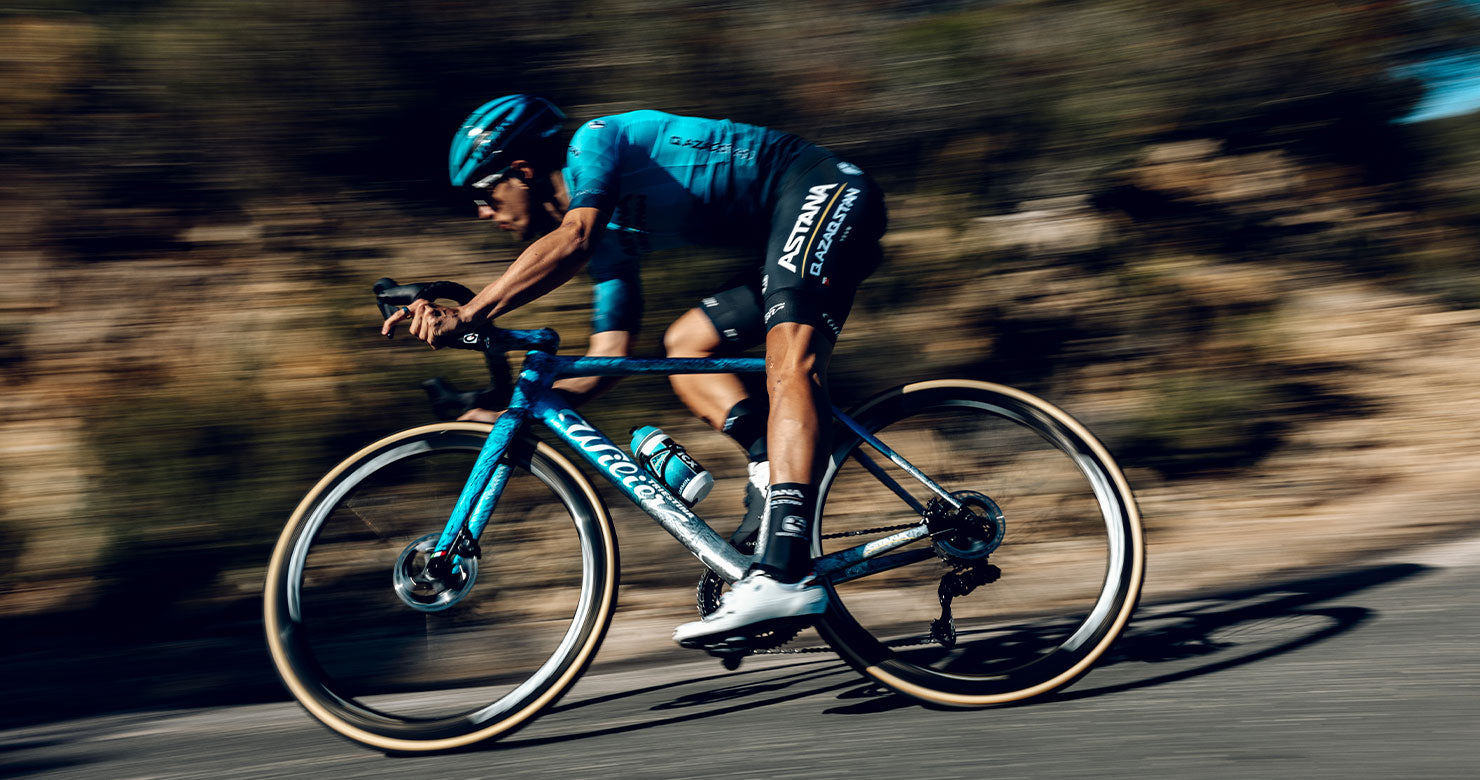

The photo is for color representation only; for specifications, please refer to the details below.
Speed, at Wilier, is not just a measurement: it is an ideal, a philosophy deeply rooted in time. For Wilier Triestina, speed is not merely a technical datum or a number in a wind tunnel: it is Culture.
An approach that combines engineering research, athlete experience, and sensitivity to design. A genuine passion for cycling and for work, born from artisan craftsmanship and a firm commitment to offer future generations an absolute and pure cycling experience.
Filante SLR ID2 embodies this vision. Not a simple update, but the most advanced expression of a tradition that began with the first Wilier aerodynamic models, passed through experiences like Supersonica SLR, and now redefines the boundaries of on-road efficiency. Every detail is created with a clear objective: to put the athlete at the center, enhancing their position, sensations, and real-world road experience, to allow them to become faster in the real world.
AERODYNAMIC DEVELOPMENT: BIKE AND CYCLIST, ONE ENTITY
Pure aerodynamic efficiency is not enough if the real-world result does not meet our quality standards for ride. When we decided to rethink Filante SLR, we asked ourselves a simple but decisive question: how can we raise the performance bar even higher? Together with the technical staff of Groupama FDJ – Cycling Team, we analyzed every detail to understand
how far we could push ourselves.
After the achievements with the Supersonica SLR, it was clear that expectations were very high, especially on the aerodynamic front. The goal? To create a bike capable of ensuring maximum efficiency even outside time trials. An ambitious challenge, which contained a paradox: combining extreme aerodynamics with lightness, responsiveness, and ride quality at the same time.
Just like with Supersonica, we didn't stop at the frame. We studied the entire racing ecosystem: complete bike, components, accessories, and put the most important element at the center: the athlete himself. Because the aerodynamics of the bike alone are not enough: what really matters is real speed, which for the cyclist translates into unique sensations and superior performance on the road.
But to develop the new Filante, we did not rely solely on racing experience: we used the most advanced CFD simulations.
Like all aerodynamic frames developed by our Innovation Lab, Filante SLR ID2 was conceived following a precise design process, with well-defined stages over time. The project brief is digitally translated into a 3D model composed of the frame, fork, and handlebar. A set of components that is virtually divided into thousands of small cells called computational mesh.
All of this serves to subject the design idea to a preliminary analysis using CFD software.
This software - by solving the Navier-Stokes equations - virtually simulates and describes the behavior of a fluid (air in our case) around an object. Once the object is defined, the physical and environmental conditions in which the object must be analyzed are decided.
In our case, air speed is the most important element. At this point, the software calculates how the air moves over the surface of each cell of the mesh. The resulting output defines how aerodynamic a 3D model is. If the results are not as expected, the 3D model is remodelled, improving shapes where possible, trying to optimize flows and thus reduce aerodynamic drag. All of this in theory.
In practice, it is all more complex. One of the first obstacles is computational power: during a CFD simulation, the computer must solve billions of small mathematical equations - one for each mesh cell - in order to best simulate air movement. This requires extremely powerful computers, equipped with hundreds of processors working in parallel. CFD simulations are therefore very expensive but allow for great freedom of experimentation: they allow focusing on the improvement of many small details, which in the end - summed together - make the real difference, leading to a substantial evolution in product performance.
The initial areas of intervention concerned the leading edge, which is the set of surfaces that first interact with the airflow and critically influence its behavior. The analysis focused sequentially on the fork, head tube, handlebar, down tube, and seat post, optimizing geometries and profiles to reduce turbulence.
A correctly designed leading edge allows for a reduction in aerodynamic drag and keeps the laminar flow adhering to the profile for longer, with a clear improvement in overall efficiency.
MORE DATA, LESS DRAG: THE FORK'S NEW AERODYNAMICS
For the fork alone, we designed and analyzed various NACA profiles, aerodynamic shapes derived from aeronautics and mathematically defined to ensure maximum efficiency in airflow. Each profile was tested in combination with the wheel and tire using CFD simulations, considering different wind incidence angles to reproduce real-world usage conditions. The process required three times the number of CFD simulations used in the development of Supersonica SLR, resulting in an exponential increase in the volume of data to be processed.
This systematic approach allowed for progressive refinement of the geometries, leading to a completely new solution: a fork characterized by an external NACA profile and a flat internal profile, designed to minimize interactions with the wheel and tire and maximize aerodynamic stability.
In designing the new fork, we paid particular attention to the head cone.
From the experience gained with Verticale SLR, we learned that a steeper inclination allows for more homogeneous carbon lamination, capable of increasing stiffness and, at the same time, reducing overall weight.
With Filante SLR ID2, we pushed this concept even further: the even more pronounced cone ensures greater torsional stiffness and superior stress resistance, improving steering precision in all conditions.
The left dropout integrates a subtle aerodynamic fin that brushes the disc and wraps around the brake caliper: a partial fairing already successfully tested on Supersonica SLR, now further refined. Finally, the thru-axle clamping bushing has been completely integrated into the right dropout:
a solution that combines aesthetic elegance, clean lines, and a tangible benefit in terms of aerodynamics and practicality.
THE HEAD TUBE: SLIM, CLEAN, FAST
The head tube has been further improved to allow air to flow more smoothly and efficiently.
The leading edge remains faithful to the previous version, but the profile now develops into more tapered and slender shapes, capable of further reducing drag.
As always, at Wilier, technology meets elegance: brake and control cables are channeled directly from the handlebars into the head tube, creating a total integration that combines aesthetic cleanliness, aerodynamic performance, and unparalleled artisanal attention to detail.
NEW F-BAR ID2 HANDLEBAR
The Filante SLR ID2 comes with the new F-Bar ID2, an aerodynamically optimized cockpit completely redesigned in collaboration with the technicians and athletes of the Groupama – FDJ Cycling Team. After developing and testing nine types of titanium-printed bends, we defined the final O.E.F. (Optimized Ergonomic Flare) version. This is an orthogonal flare of 3 cm between the upper and lower grip, which, unlike other handlebars with differentiated widths on the market, does not compromise the ergonomic studies designed by transmission control manufacturers.
An absolutely exclusive solution that provides the cyclist with greater control in the drops, a more compact and aerodynamically efficient position, and a natural and comfortable grip. The control area features a slight upper rise that improves forearm support in the stretched position, increasing comfort and stability during long rides without sacrificing stiffness.
Integration with the frame has been optimized by lowering the head tube and introducing new top covers and concave spacers that increase the contact surface, improve responsiveness, and ensure aesthetic continuity, while the convex shape of the curve reduces the height difference between the handlebar and top tube, improving aerodynamics.
For the first time on a Wilier product, the handlebar fixing hardware is completely hidden, benefiting aesthetics, protection from dirt and sweat, and aerodynamic performance. Filante SLR ID2 is also compatible with V-Bar, Z-Bar, and F-Bar ID1 handlebars.
DOWNTUBE AND AEROKIT, THE MOST COMPLEX CHALLENGE
The downtube, always one of the most complex areas from a design perspective, has been developed with a precise objective: to have minimal aerodynamic drag and to reduce the exposure of water bottles to the air as much as possible.
To achieve this result, we chose a dual-section solution. The upper part, very thin and shaped according to a NACA profile, works close to the head tube to ensure maximum aerodynamic penetration. The lower part, on the other hand, is wider and more enveloping, designed to incorporate and shield the water bottles, reducing the turbulence that traditionally occurs in this area.
From the very first tests, even using round water bottles and traditional bottle cages, the design proved to offer a clear improvement in performance. We decided to push further for greater integration and to further reduce air drag. This is where the Aerokit project took shape, a system of custom water bottles and bottle cages, with a tapered profile and completely integrated into the frame, which acts as a kind of spoiler capable of making the airflow cleaner and smoother.
CFD simulations immediately confirmed our intuition with unequivocal results. With a round water bottle combined only with the Aerokit base, aerodynamic drag is reduced to less than half compared to the Filante SLR ID1. With the complete Aerokit, drag is reduced by even more than two-thirds.
In the CFD visualizations, the analyzed section clearly shows how the new downtube, combined with the integrated system, generates an extremely more organized flow within the main triangle: the turbulence-free area, represented in red, is much more extended on the Filante SLR ID2, highlighting a concrete technological leap in terms of aerodynamic efficiency.
AERODYNAMIC SEATPOST AND NEW SHIMANO DI2 BATTERY HOUSING
Designing a truly aerodynamic seatpost is an exercise in engineering precision. An seemingly simple component becomes a difficult puzzle to solve and crucial for the overall efficiency of the bike: its impact on aerodynamics is not limited to the frontal surface, but is amplified through interaction with the cyclist's alternating leg movement.
With the experience gained in developing the Supersonica SLR, we already had the right formula: a balance between aesthetics, lightness, and comfort. The new Filante SLR ID2 seatpost stems from this recipe, with a thin and sharp profile (38 mm x 16 mm), which optimizes aerodynamic penetration without compromising stiffness and vibration absorption. CFD tests confirm it: the new section generates significantly less turbulence than the previous version, resulting in a cleaner and more stable airflow around the frame-cyclist system, a central element in the development of Wilier products. This design choice also led us to rethink the placement of the Shimano Di2 battery, historically located in the seatpost. With such a slender design, it was necessary to find an alternative and more efficient solution. The answer came by moving the battery to the bottom bracket shell, enclosed in a resin case fixed with two screws.
The advantages are immediate and concrete:
• Accessibility: the battery can be checked or replaced in a few moments, without removing the seatpost or changing the saddle height.
• Lower center of gravity: the new position helps to lower the bike's center of mass, in synergy with the lowered Aerokit. The result is a more stable, precise, and fluid bike at high speeds.
Finally, a design detail that encapsulates the project philosophy: the protective rubber cap for the seatpost clamping mechanism is no longer protruding, but flush with the frame. A clean and functional solution that enhances the continuity of the top tube's lines and emphasizes attention to detail, a perfect blend of function and aesthetics.
REAR DROPOUTS: A SILENT REVOLUTION
We chose to preserve the family feeling with the previous Filante, maintaining wide rear dropouts inserted into the seat tube through a broken line, capable of giving the frame a decisive character when viewed from behind.
To a superficial eye, they might seem similar to the ID1 version, but in reality, they have been redesigned in every detail. The analyses of the dynamic interactions between the dropouts and the cyclist's leg movement during pedaling led us to an unexpected solution: tilting the dropouts inwards by 2.5°. This seemingly counterintuitive choice showed clear benefits in CFD simulations.
In the comparison graphs, in the dedicated section, it is clear how the combination of the new lowered water bottle position and the redesigned dropouts generates a cleaner and more regular flow, with a drastic reduction in turbulence. Once again, the optimization of aerodynamic flow is born by putting the cyclist at the center: this solution allows us to further increase speed while maintaining the same watts produced by the cyclist.
POWERMETER MAGNET HOUSING: AERODYNAMICS IN EVERY DETAIL
The search for marginal gains has prompted us to rethink a detail often overlooked: the position of the powermeter magnet.
We designed a dedicated recess on the drive-side chainstay, intended to optimally house the magnet. Once installed, it is protected by a flush-applied adhesive, making it practically invisible to airflow and perfectly integrated into the frame design.
Even if the powermeter is not used, applying the adhesive still provides the same aerodynamic benefits and aesthetic cleanliness of the frame.
This solution, in addition to improving aerodynamics, ensures effective protection of the magnet from accidental impacts or chain drops, increasing the overall reliability of the system.
THE VERDICT FROM THE SILVERSTONE WIND TUNNEL: MEASURABLE PERFORMANCE, REAL ADVANTAGES
The new Filante SLR ID2 is the result of a meticulous development process, with numerous test sessions and data validation in the prestigious Silverstone wind tunnel. Every step was designed to go beyond CFD simulation, translating the project into concrete and measurable results.
The verdict was unequivocal: reality surpassed simulation. In the last test session, the drag reduction of the bike alone reached -13.6%, exceeding the -12% estimated by CFD simulation. Even in the bike + rider system, a central concept for Wilier, the data surprised: from -3.6% CFD to -4.5% real. Data showing how the design of the Filante SLR ID2
achieves its full potential in real-world usage conditions.
But we didn't stop at internal validation. We compared our bike directly with five top-of-the-range models from major World Tour competitors. Only one managed to come close: compared to the others, the Filante SLR ID2 recorded an average CDA better by 2.42%.
A difference that, at professional cycling speeds, means seconds gained, energy saved, and concrete advantages when it really matters: in a race.
The Filante SLR ID2 is not only the result of visionary design: it is a race-proven bike, designed to win and capable of transforming science into concrete advantages for the athlete.
AERODYNAMICS AND LIGHTNESS, THE KEY TO PERFORMANCE
Lightness has remained one of the key pillars to ensure high-level performance. In the design of the new Filante SLR ID2, this principle has always been a focus. The result is a bike that perfectly combines aerodynamic efficiency and low weight, an essential combination in modern cycling.
The combination of aerodynamics and lightness enhances responsiveness and efficiency, reducing fatigue and optimizing power management. Performance thus translates into a concrete advantage for the bike-cyclist system, making the Filante SLR ID2 extremely versatile, from the toughest climbs to long flat rides.
In tests conducted on the bike alone, at 40 km/h there is a saving of 8.9 watts with standard water bottles and bottle cages, and 9.47 watts with the Aerokit; values that at 50 km/h increase to 19.13 watts and 21.20 watts respectively. The effectiveness becomes even more evident considering the bike-cyclist system together: at 40 km/h the advantage for the rider is 11.51 watts with standard water bottles and 14.15 watts with Aerokit, while at 50 km/h the savings rise to 24.55 watts and 28.80 watts.
Translated into real performance, this means that in a 70 km time trial at an average of 290 watts, the cyclist would take 1 minute and 25 seconds less with the new Filante SLR ID2 equipped with standard water bottles, and even 1 minute and 45 seconds less with the Aerokit.
THE CULTURE OF SPEED, WILIER TRIESTINA'S CREED
The Filante SLR ID2 represents the evolution of an idea: to give the cyclist the fastest version of themselves. From the NACA profiles of the fork to the new Aerokit, from the redesigned seat post to the perfect integration of the Shimano Di2 battery, up to the geometries developed with World Tour champions. Every element converges towards a precise objective: to offer scientifically validated performance, measurable advantages and authentic sensations on the road.
But the Culture of Speed goes beyond numbers. It is a philosophy that has guided our way of building bicycles for 120 years. This culture guides every project, pushing us beyond performance for its own sake towards a conscious research that combines experience, ingenuity and technology. Our goal is perfect movement: that harmonious balance between cyclist and bicycle where strength, precision, aesthetics and function merge.
With the Filante SLR ID2, we transform data into emotions. Numbers do not represent the finish line, but the starting point for creating bicycles that truly communicate with those who ride them. This is how we remain faithful to a promise that has always accompanied us: to create the means to make you the fastest version of yourself.